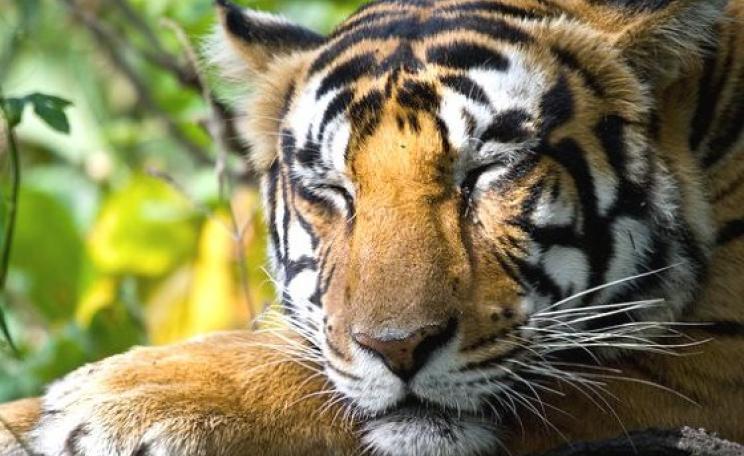
Tiger cubs suckling on pigs. Sounds bizarre, but that is how tiger farms in Thailand and China are turning tigresses into a baby-making machines to supply the ever-hungry market for tiger parts.
Wean a tigress’ cubs off her prematurely and she will quickly come back in to oestrus. A successful tigress in the wild may raise a litter of up to four cubs to adulthood every two and half to three years. At a tiger farm in Thailand, a tigress can have at least one litter a year.
Some facilities are up front about their motivations. They claim their objective is simply to have the single largest collection of tigers, with cages crowded with young tigers. In China however, a sinister series of events has been unfolding. There are believed to be over 5000 tigers in captivity across China, and one of the biggest operations has approximately 1300 tigers.
The company behind the farm launched its operations in 1986 to supply the medicinal trade, but continued breeding tigers beyond 1993, despite the introduction of China’s domestic tiger trade ban. They were speculating - and banking - on the ban being temporary.
It must be said that China’s domestic tiger trade ban has made a vital contribution to international efforts to save the wild tiger. Without it, and the accompanying awareness and outreach efforts, the demand for wild tigers would be far worse than it is. Now is not the time to take the foot off the gas: efforts to improve enforcement and send a clear message to potential consumers must be sustained.
Unfortunately, business interests are hijacking the tiger conservation agenda, calling for the relaxation of the trade ban so they can flood the market with farmed tiger parts. The logic behind such a move is that since tigers breed well in captivity, farming them is an economical solution to satisfying demand whilst alleviating pressure on the wild tiger.
It’s a flawed logic that rests on simplistic assumptions about the complex nature and dynamics of the illegal trade in tigers and other Asian big cats. Assumptions are made about the motivations of those involved in the trade, the costs of the trade, the scale and type of consumer demand. They are then all plugged in to economic models and squirted out the other side as gospel. What the followers of this faith have failed to acknowledge is that their version of events does not hold true in the real world, and the risks of carrying on with this experiment are enormous.
The market the tiger farmers want to exploit is not the traditional medicine market, rather it is the luxury high-end market for tiger bone wine. In fact some businessmen are so keen they have already been found in breach of Chinese law, illegally selling tiger bone wine in tiger-shaped bottles and in one case, selling tiger meat. EIA and others have found tiger bone wine being marketed both as a general tonic and as the gift that wins promotions and seals deals.
On top of this, EIA has repeatedly sought clarification from the Chinese government over a flawed registration scheme that would appear to allow the labelling and sale of farmed tiger and leopard skins.
The markets for tiger bone wine and tiger skins are potentially massive; this is not just about reigniting an old demand, it’s about stimulating a new, diffuse and poorly understood one.
The very existence of these farms, and the persistent lobbying of the business community is a distraction that deflates and undermines real tiger conservation efforts. We’re being asked to believe that those who have already dabbled in illegal trade have a real interest in limiting their market and that the enforcement authorities, which have failed to stop them so far, will be able to regulate a legal trade to prevent the laundering of poached tiger parts. It’s hard to swallow.
In June 2007, the international community spoke with one voice: it declared that tigers should not be bred for any trade in their parts and derivatives. Parties at the 14th meeting of the Conference of Parties to the UN Convention on International Trade in Endangered Species (CITES), adopted a decision to phase out commercial tiger farms.
The move was championed by the governments of tiger range states such as India, Nepal, Russia and Bhutan, all desperately appealing to the international community to remove the tiger farm threat once and for all. Two years on however, those countries with tiger farms have failed to provide any evidence of progress.
This was the subject of discussion at the recent meeting of the CITES Standing Committee, the body that monitors CITES management and implementation. India, the EU, the USA, Iran, and Australia all expressed concern and supported calls for a second deadline by which relevant countries report on steps taken to implement the Decision. The World Bank weighed in, their lead economists having reviewed and debunked the theories the pro-tiger trade movement have relied upon.
Progress will be assessed again at the main CITES meeting in March 2010, the next Chinese Year of the Tiger. Will China, in the interests of the wild tiger, send a strong and clear message by fulfilling the CITES Resolutions and Decisions to phase out farms, consolidate and destroy stockpiles of tiger parts and derivatives and invest in more effective enforcement?
In the meantime, India took the opportunity at Standing Committee to remind us all of the greater ecological and cultural significance of the tiger, how it represents the very forests that mitigate climate change, secure water and deliver other ecosystem services. How the wild tiger is not just a commodity that can be treated in isolation.
EIA firmly believes there is much more that can be done to combat the illegal trade in wild tigers and other Asian big cats. With increased financial and political commitment, governments can adopt more targeted, intelligence-led efforts to disrupt the criminal networks that control the trade between range, transit and consumer countries.
In so doing, we bring far greater benefits, not just to the survival of the wild tiger, but also to all other endangered species.
Debbie Banks is lead campaigner at the Environmental Investigation Agency