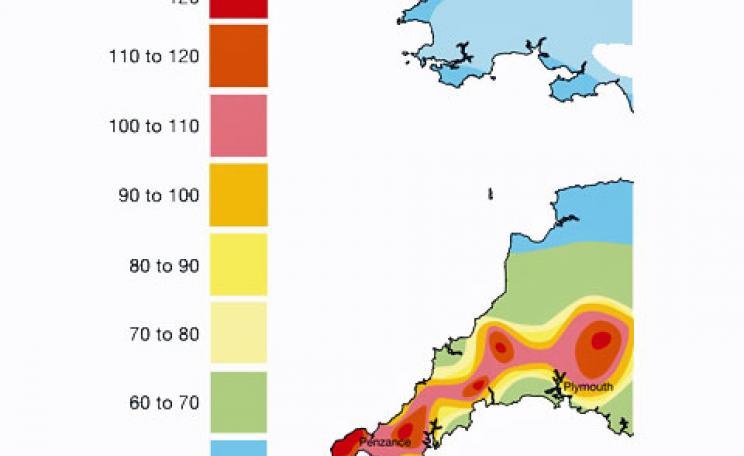
Three geothermal projects to generate heat and electricity from hot rock deep underground have been given government funding this week.
More than £2 million has been given to two separate developments to search for underground heat sources in Cornwall, one of which is at the Eden Project, the other near Redruth.
A further £460,000 has been handed out to a smaller Newcastle University-led project to provide renewable heat to a new eco-village in County Durham.
If successful the three exploratory drilling projects would mark the first signs of a geothermal sector in the UK. Germany already has an estimated 150 geothermal power plant projects in the pipeline.
Geothermal energy involves pumping water usually up to 5km underground where hotter rock temperatures heat the water before it is pumped back up to the surface to either be converted into electricity or used as a source of renewable heat.
The biggest potential for a UK sector is expected to be in Cornwall where extensive research in the 1970s and 80s found significant opportunities in the granite rock. Both of the Cornish projects which received funding from the Department of Energy and Climate Change (DECC) this week said they had relied heavily on the research.
The company behind the project near Redruth, Geothermal Engineering Ltd, intends to start drilling its first borehole in October 2010, if it gets local planning permission.
Operating by 2013
Both the Redruth and Eden projects could be producing energy as soon as 2013.
Ryan Law, managing director of Geothernal Engineering Ltd, said their plant would produce 10MW of electricity for the national grid (3MW of which will be used to power the pumps and cooling equipment) and 55MW of renewable heat, which he hoped would be supplied to the local community.
In contrast to wind, geothermal is also able to operate 24 hours a day.
'It keeps on running so that over the course of a year the amount of electricity produced is equivalent to 21 wind turbines,' said Law.
Responding to concerns about noise, Law said although drilling would take four months the 50m high rigs would be 'very quiet - less than 50 decibels from more than 100m away'. He also said the entire plant would be no bigger than a bungalow.
Useful links
DECC funding annoucement

| READ MORE... | |
 |
NEWS ANALYSIS Carbon: from pollutant to potential resource Instead of dumping carbon deep underground we could be exploring ways to use it and reduce our overall emissions at the same time |
 |
HOW TO MAKE A DIFFERENCE CASE STUDY: running a sustainable waste service in Kenya Worldbike is using customised bicycles to kick-start rubbish-hauling enterprises in Kenya's poorest neighbourhoods |
 |
NEWS Wind turbines have no impact on house prices Ten-year survey of house sales in US finds wind turbines have no negative affect on market price despite public fears |
 |
INVESTIGATION Biochar: can charcoal really stop global warming? Biochar - the charcoaled remains of agricultural waste - is being hailed as a huge opportunity to reduce the levels of carbon dioxide in the atmosphere. But is the science sound, and do we have enough waste to go around? |
 |
INVESTIGATION Can cows help stop climate change? Meat, dairy... in fact, livestock in general has in recent years joined the ranks of the 4x4 and the short-haul flight. But could a change in the way we graze animals not only reduce greenhouse gas emissions, but even remove them from the atmosphere? |