The Ecologist


Desert world

One per cent of the surface area of the world's deserts would be enough to meet our current electricity needs

More articles about
Related Articles

What's stopping us getting solar power from deserts?

Mark Jansen

10th February, 2010

Plans to use concentrating solar power plants in the Sahara to generate and export electricity have been on the table for years. Now, it looks as though political will might help move things forward

The logic of the idea would seem obvious to a child: the human race needs to wean itself off fossil fuels, so why don't we build solar power plants in the world's deserts, to give us all the energy we need?

This concept has long been promoted by Desertec, a European network of scientists and engineers, which argues that just 1 per cent of the surface area of the world's deserts could generate as much electricity as the world is now using.


What do you think? Comment here


Desert solar power

Desertec envisages a massive deployment of solar technology in Middle Eastern and North African countries, exporting electricity to Europe. The vision may seem idealistic, but there have been signs recently that politicians and industry are starting to take the Desertec proposals seriously.

A recent Desertec seminar at the House of Commons was attended by the energy minister Lord Philip Hunt, as well as the Conservative shadow energy minister Charles Hendry and the Liberal Democrat shadow secretary of state for energy and climate change, Simon Hughes.

All three professed support for the concept, with Lord Hunt declaring, 'I am very interested in the work that you are doing.' Just words? Maybe. But Hunt promised that the Desertec will be seriously considered by the European Commission as it tries to make plans for future supplies of renewable energy for the whole region.

Taken seriously

The European Union is aiming to provide 20 per cent of its energy from renewable sources by 2020, and a much higher percentage by 2050. With this in mind, the European Commission has begun drafting the Strategic Energy Technology Plan, which will attempt to explain how renewable technologies can be made mature enough to supply a large part of Europe's total energy needs by 2050.

The SET Plan, as its known, is still in its early stages, but Desertec is part of the deliberations. Gus Schellekens, a director in the sustainability and climate change team at business advisors PriceWaterhouseCoopers, sees the SET Plan as a tentative first step towards the kind of European unity needed to make Desertec a reality.
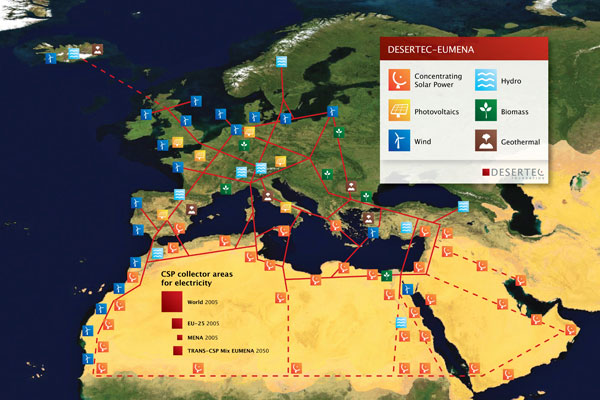
The project would involve power lines being stretched across the desert and Mediterranean sea
The Desertec project would involve power lines being stretched across the desert and Mediterranean sea

Supergrid


A key part of the Desertec vision is for a 'supergrid' that can distribute renewable energy across Europe, be it hydro power from Scandinavia, wind power from the UK or solar energy from the Mediterranean states and North Africa.

In addition to building this supergrid, the European states would probably also have to agree a system of subsidies to make solar electricity imported from North Africa commercially viable.

'The SET Plan has the potential to be what's needed,' says Schellekens.

Next month he will publish his own report on the future of renewable power in Europe and North Africa, which argues that unified political support for Desertec across Europe is essential before investors will risk their cash to fund the building of solar power plants in North Africa.

'Unless you have the right signals coming from government level, you don't have what the market needs, nobody moves and no-one does anything,' says Schellekens.

Price barrier


The sheer cost of solar power is another obstacle.

Electricity produced by even the cheapest solar technology still works out at $160 per megawatt hour (MWh), compared with just $60 per MWh for electricity produced by coal-fired power stations and $80 per MWh for the most efficient gas-fired power stations, according to Jenny Chase, senior solar analyst at Bloomberg New Energy Finance, which analyses investments in renewable energy.

Chase acknowledges that government subsidies in Spain and Germany have already helped bring down the cost of solar power dramatically, but she finds the Desertec concept unconvincing.

'The idea is to generate an expensive form of power and then transport it across long distances. That doesn't stack up without significant amounts of subsidy. I don't know if that will come, but I suspect that given the timescales involved, solar power may become cheap enough to deploy widely in Europe without needing to transport it from north Africa,' she says.

African solar industry


North African governments are taking steps to build their own solar industry.

The seminar at the House of Commons included a presentation from the Morroccan energy minister, Amina Benkhadra, who is seeking $9bn of investment to build 2000 megawatts of solar capacity in Morocco by 2019.

Tunisia has launched a similar scheme, the Plan Solaire, and Schellekens expects further solar plans will soon be launched by other North African countries. For the moment, he doubts there is much enthusiasm among investors:

'We are at a point in the [economic] cycle where lots of money has been lost and what is left is being looked after carefully.'

The private sector has also begun to investigate Desertec. Last July in Munich, 12 energy and financial companies including Deutsche Bank and E.On agreed to finance a three-year feasibility study, known as the Desertec Industrial Initiative.

The group has been convened by Munich Re, the world's largest reinsurance group, which believes solar power in North Africa could deliver 15 per cent of Europe's electricity by 2050.

Concentrating solar power

Desertec supporters say the technology needed to carry out the plan already exists. It advocates the use of concentrating solar power, whereby mirrors are used to concentrate sunlight into small areas to generate heat. This heat is used to generate steam, which in turn drives turbines to generate electricity, just like a conventional power station.

The advantage over conventional solar panels is that it does not need expensive silicon. It does, however, need lots of direct sunlight, which makes it ideal for deserts but less suitable for most European countries.

Another advantage is that generation can continue at night, using spare heat that has been stored in tanks containing melted salts or in concrete blocks. Six concentrated solar power plants are already up and running in Spain and several more are under construction.

Lord Philip Hunt warns, however, that the technology will need to prove itself on a large scale - running at hundreds of megawatts rather than demonstration-scale plants producing merely tens of megawatts - before Desertec can take off. He also pointed to the massive scale of investment that would be needed, most of which will have to come from the private sector, plus the importance of creating the right regulation across Europe, 'which will not be easy'.

Encouragingly, Hunt concluded, 'none of these challenges is insurmountable'.

Useful links

Desertec Foundation

 

READ MORE...
COMMENT
Solar lighting spells the end of kerosene in Africa
A simple but effective solar kit is helping to bring light to homes in the less-industrialised world without the choking side-effects of kerosene lamps
HOW TO MAKE A DIFFERENCE
India's plan for a solar power revolution
India is set to embark on the country's largest solar endeavour - increasing solar capacity from 3 megawatts to 20 gigawatts by 2020
NEWS
Under the hood of the solar electric car
Cambridge University's solar electric car 'Endeavour' was unveiled in July as a contender in the Global Green Challenge - a gruelling race across the Australian outback in October.
HOW TO MAKE A DIFFERENCE
PHOTO GALLERY: Visionary architect unveils eco designs
An exhibition in Beijing reveals architect Paolo Soleri's latest radical green city concept
NEWS ANALYSIS
Local electricity: Africa goes off-grid
Giant wind farms may grab the headlines but plans to develop local off-grid electricity will have bigger impact on Africans and carbon emissions


Previous Articles...

Users Comments

Re: What's stopping us getting solar power from deserts?
Posted By DanielH 1 February 10, 2010 05:21:24 PM

Surely the solar power will be better used to provide electricity for Africa rather than feeding our ever-growing needs??

Re: What's stopping us getting solar power from deserts?
Posted By robtemery 1 February 11, 2010 01:12:10 AM

Transmission line technology. The static one hears on the radio driving next to a high voltage transmission line is those little electron escaping. Over a long distance many get away. Superconducting transmission lines do not exist yet and when they do, why not run a line around the planet and use solar 24/7.

Re: What's stopping us getting solar power from deserts?
Posted By conquistador 1 February 11, 2010 03:22:24 PM

We should use the benefits from the trade of oil and gas,in order to develop those solar and eolic facilities as soon as posible ,no matter the cost,something as to be started fast,because in the future we will blame the past for not constructing it,the earth is hurt and whith the velocity that mankind is using fuels,we are not going to have clean air to breath very soon.

Re: What's stopping us getting solar power from deserts?
Posted By EC001719 1 February 11, 2010 05:26:55 PM

If we are to phase out fossil fuels and avoid nuclear, we must find some very large new sources of electricity - even more so if we want to replace some of the oil used in transport with electricity. One of the few such sources is the DESERTEC project to bring solar energy from N Africa to Europe: it's now a $400bn project led by a German consortium. DESERTEC is actually much more than this - it's a complete electricity plan for Europe with low loss transmission lines linking different types of renewables, wind, hydro, biomass and it phases out nuclear. There is a great FAQ page about it here: http://www.desertec.org/en/concept/faq/ which answers most of the concerns people have raised. Very few people in the UK know about it, despite the fact that it dwarfs our government's nuclear plans. There is masses of info on their website and reports you can download - please please do read them before dismissing it.

Re: What's stopping us getting solar power from deserts?
Posted By EC001719 1 February 11, 2010 05:39:28 PM

Apologies for adding a second post, but I omitted to say that the article is a little out of date. The project is now going ahead and plans to deliver solar power by 2015 - long before any new nuclear is completed. See: http://news.bbc.co.uk/1/hi/8337735.stm Also N African countries are very interested in the project which they see as a sustainable source of jobs, electricity and desalinated water.

Re: What's stopping us getting solar power from deserts?
Posted By jonnycrh 1 February 11, 2010 08:40:40 PM

Another reason why Desertec is not the best means of powering Europe is that we need to be held responsible for our appetites. If we need electricity we have a moral duty to bear the burden ourselves as much as possible. It has the potential to be a classic Big Solution to a Big Problem – the dreaded geo-engineering. The glib attitude along the lines of "We live in a global world now and need global solutions" has got us into the mess we are in today. It has hooked us on off-shoring our consumerist desires and into assuming that big questions are best solved by big answers, probably based far over the horizon in someone else’s back yard. Nevertheless, I do concede there is some sanity in this project – but only insofar as it is just a minor part of the answer to our need for electricity and mainly a means of equalising the many quality of life disparities between Europe and Africa. The main part of our power generation should come from much closer to home and should focus on onshore wind backed up by a smart grid using vehicle-to-grid and other dispersed storage technologies – by far the quickest, most easily scaleable, cost effective, robust and diverse means of ensuring the UK's energy security.

Desertec is Wind too
Posted By EC001719 1 February 11, 2010 11:03:35 PM

I should love the UK to generate the maximum amount of energy near to home - micro generation on buildings and a big expansion of wind. The Desertec concept is that all countries contribute what they can to the mix, as can be seen on the map in the article - wind from the Atlantic countries, geothermal from Iceland, hydro from Norway, solar CSP from the south, photovoltaics from most places. Several of the countries where CSP plants would be located are currently oil or gas exporters. When that business goes their economies could collapse - Desertec is a lifeline for them. See: http://www.rechargenews.com/energy/solar/article202819.ece "In November 2009 Morocco announced it will install 2 gigawatts of solar capacity by 2020. The first of its five planned CSP stations will be a 500-megawatt plant in the southern town of Ouarzazate. Morocccan energy minister Amina Benkhadra says Morocco has already received expressions of interest from several large foreign companies. When finished in 2020, the five solar plants will account for 38% of Morocco’s total installed power-generation capacity, while covering 20% of its total electricity requirements. Morocco is sharpening its elbows to compete with neighbouring North African countries Algeria, Tunisia and Libya for a slice of the €400bn ($573.8bn) bonanza expected to come from the Desertec Industrial Initiative. "

solar power from deserts?
Posted By stopco2 1 February 11, 2010 11:50:21 PM

Do not give people TOO EARLY fresh ideas and examples they can have free energy for householding + free combustion for transport when they put solarpanels on THEIR ROOFS with their taxmoney without first paying increasing invoices from a Megacorporation selling expensive electricity through cables and wires .First let them pay for windmills , concrete , roads and steel with their taxmoney (destruct mountains , have headaches , no sleep and Low Frequency Noise syndrome , kill birds and bats ,...), If you make Solar in the dessert :1º prices of solar decrease 2ºYou break the myth that solar is not rentable and very expensive .Hold the power and control .When you control energysupply (+foodsupply) you control people ....???never ending story ...or do we wake up and ask ourselves ..TAXMONEY ...DO THEY DO US A FAVOUR WITH IT !!Free energy for the people now = the beginnig of a solidarity society . Greetings from STOPCO2.COM Namaste .Sun is shining for us !

Energy from the Soul .
Posted By stopco2 1 February 11, 2010 11:54:26 PM

Universal Declaration of Human Rights: Article 1. All human beings are born free and equal in dignity and rights.They are endowed with reason and conscience and should act towards one another in a spirit of brotherhood and also all those (human beings?) who think money is God and their marionette-robot-rulers who are... leading the rest of human beings in name of peace , freedom ,democracy and free trade to disaster , they also have to remember that we never surrender .Questions arise - apart from the dead birds and bats , the infernal Low Frequency Noise and destruction done to nature and landscapes , the low rentability of that old technology -when you do not see any windmillpark on village-communityground + machines owned by the village/townhall.Electricity companies pay a rent to private big landowners who forsake fertile soil + mill installation done with important subventions from government(s) paid by Taxpayers ...... sell expensive electricity to the same taxpayers...It has to be a RIGHT for humanity to have free energy .Fotovoltaic solarpanels on our roofs ,warmth , transport for FREE reconvert cars and geothermal heating. With the Time we earn then we can Reforestate ,change lifestyle ,concentrate on really important things like : drink Water , abolishing and removal of all weaponry including conventional arms ,education of our kids (Yoga and traditional Martial Arts in schools for our youngsters , basics for a fair society , peace and health ....when basics are no good ....never will there any progress ), grandparents and Family ,food and eco cities...Solidarity Society ..or do we never learn ???The earth is round…...not a pancake . ?What they do with our Taxmoney ..you think they make us a favour with it ? ! Free energy now ! Solutions are in front of our nose .. www.stopco2.com .Namaste

Re: What's stopping us getting solar power from deserts?
Posted By steveplater 1 February 12, 2010 10:20:33 PM

Why do you suppose Big Electricity are so keen on Desertec? Because it is a way of making solar energy large scale and centralised – so that they can control and sell it. The alternative of millions of people having their own power station on their roof is much less palatable to them.

Re: What's stopping us getting solar power from deserts?
Posted By steveplater 1 February 12, 2010 10:21:16 PM

Why do you suppose Big Electricity are so keen on Desertec? Because it is a way of making solar energy large scale and centralised – so that they can continue to control and sell it. The alternative of millions of people having their own power station on their roof is much less palatable to them: far too democratic!

The reason why CSP has to be in S Europe or N Africa, not on your roof!
Posted By EC001719 1 February 13, 2010 03:26:16 PM

I am an engineer but not connected to any power company. I strongly support solar PV and initiated a project that put panels on my son's London school - I also have my own. The CSP technology however is not suited to microgeneration or to the UK. It requires large steam turbines and must be located in countries with lots of direct sun that can be focussed onto the boilers. I have toured one of the early plants in southern Spain (Plataforma Solar de Almeria www.psa.es) and it is a strikingly benign technology - just lots of simple frameworks of metal holding the mirrors and steam turbine plant or stirling engines. It is open to the public - do visit if you are nearby on holiday. The Desertec plan supports wind, microgeneration by PV, etc. but there a huge advantages in also having CSP. PV in the UK will generate very little in midwinter, whereas in N Africa the sun is much more intense and almost constant throughout the year. CSP can also operate through the night by storing heat. And the total potential exceeds all other power sources available many times over. The Desertec project includes microgeneration by PV on roofs across Europe - the people who fear it are the nuclear lobby.

The Club of Rome
Posted By EC001719 1 February 15, 2010 08:35:43 PM

Desertec is an initiative of the Club of Rome who also commissioned one of the key environmental books "The Limits to Growth" published back in 1972 and recently updated. I understand the concern about huge infrastructure. Most of our fossil fuels are used for heating an transport. If we eliminate them as I hope we will, electricity will probably be needed to cover whatever reduced level of transport and heating needs we are able to reach.
Post a Comment
 

Members