The debate has shifted around Isreal/Palestine in Germany.
The direct action climate network Ende Gelände has returned to frontline national activity in Germany after almost four years of focussing on local campaigns and an intense internal debate about the genocide taking place in Gaza.
The first large scale action camp by Ende Gelände since 2022 went ahead from Sunday, 24 May 2026 through to Tuesday, 2 June in Hamm, Germany.
A total of 2,000 people attended the climate camp, of which around 1,500 people took direct action in five blocks over the last Friday and Saturday of the event. Of these, 500 were internationals from outside of Germany.
This article has been published through the Ecologist Writers' Fund. We ask readers for donations to pay some authors £250 for their work. Please make a donation now. You can learn more about the fund, and make an application, on our website.
Neo-colonial
The international participants included climate justice organisers from Uganda, Malaysia, the Democratic Republic of Congo, Mozambique, Argentina, Kurdistan and the Yukpa Indigenous Communities in Venezuela. Greta Thunburg was also there, and participated in the actions.
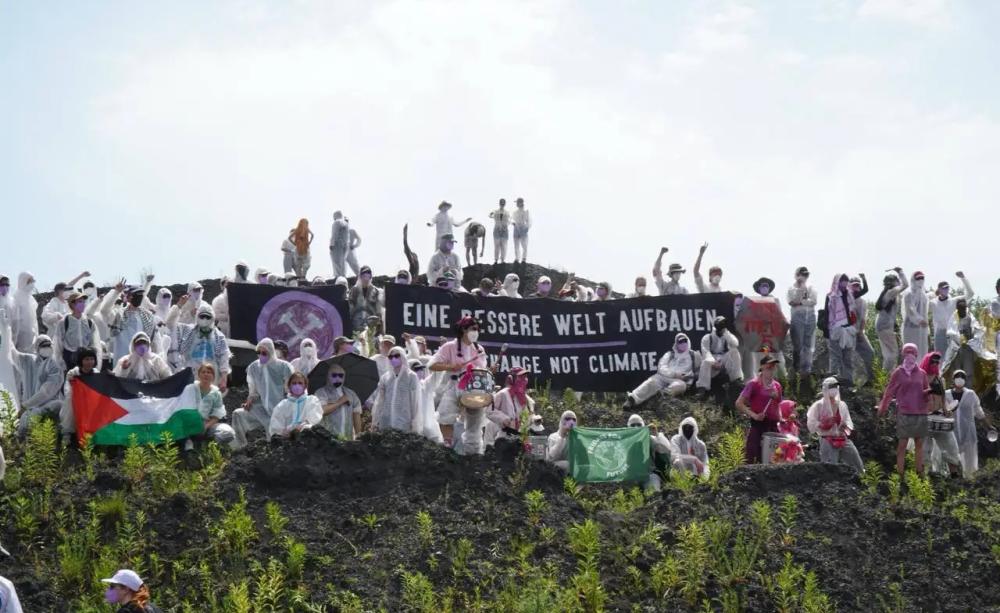
The actions were against the weapons industry and new fossil gas infrastructure. The camp had a notable pro-Palestinian stance, a continuation of the shift away from a pro-Zionist position of much of the left in Germany of the last 30 years.
The perspective of the camp and the action days was to connect the dots between the struggle against Germany’s transition from coal to fossil gas with the struggles against militarism and foreign wars of aggression.
The objectives included highlighting how fossil gas is inherently volatile - because it is pegged to international markets in these times of the US’s war on Iran and Russia’s war on Ukraine, and in amidst Isreal’s genocide in Gaza and Palestine and Turkey’s authoritarian war against the Kurds.
The activists also wanted to show how the inherent fossil capitalism of the German state has led to a ‘dash for gas’ in response to the climate movement’s push for an end to coal in a way that relies on the dispossession of people in the global south in areas of fossil gas extraction, amounting to neo-colonial, extractive and unequal global economic power relations between nations.
Pipeline
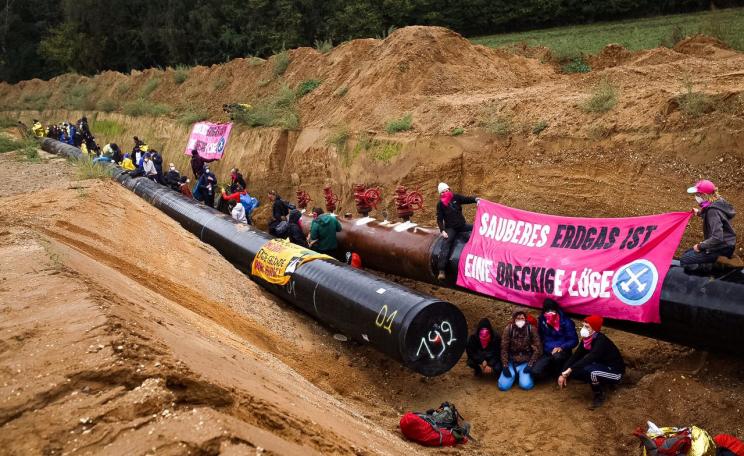
The camp also raised awareness of the fact fossil gas is not in fact a ‘bridging fuel’ between coal and renewables and leads to energy price hikes, lack of energy security and global instability. That the answer lies with home-grown renewable energy that the climate movement in Germany has been calling on for over 20 years.
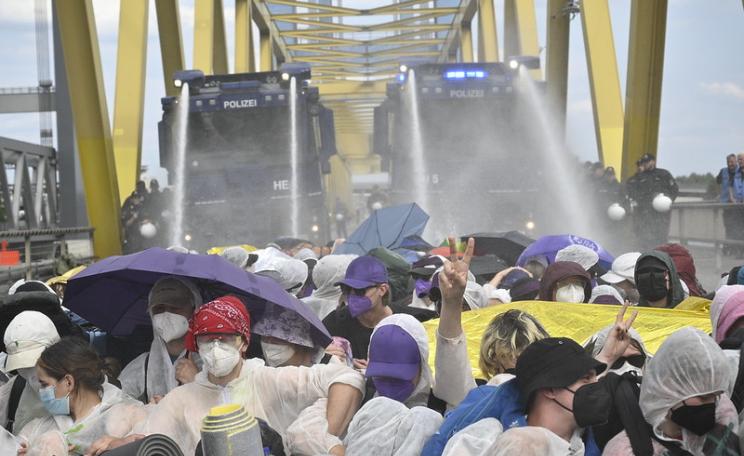
The first blockade began at 4:20am on the Friday with the "rainbow finger" blocking the sole entrance and exit to the KNDS steel plant in Mülheim, which contributes to the production of tanks to be sold to foreign aggressors. Many of these tanks have been used by the Turkish regime to suppress the Kurdish freedom struggle.
The debate has shifted around Isreal/Palestine in Germany.
Production at this facility was halted for a day as a result of the blockade, costing KNDS an estimated €200,000.
The second blockade was also in Mülheim, this time targeting Europipe, Europe’s largest pipeline producer. Hundreds of activists occupied the railway tracks servicing Europipe’s factory, which has provided pipes for LNG infrastructure including for North Sea oil and gas extraction, Nord Stream, Nord Stream II, the Trans Adriatic Pipeline (TAP), and the Trans Anatolic Pipeline (TANAP).
Decommissioned
Trains had to be cancelled, leading to production restrictions. Activists hung a massive banner off one of Europipe’s buildings stating, "exit gas now".
The third blockade took solar panels to the construction site of a brand new gas-fired power plant in Scholven. This site is the location of a coal-fired power plant that was decommissioned in 2023 as a result of Ende Gelände’s mass actions against coal since 2015.
The company Uniper is directly transitioning from coal to gas. It has already built one gas-fired power plant in 2024, and is now constructing another. The solar panels that the activists brought were used to power a giant inflatable wiggly person with the face of Katherina Reiche, the minister of economic affairs in the German government.
The fourth blockade shut the access road to the Voerde power plant in Dinslaken. The company RWE plans to build a new fossil gas-fired power plant on the same site by 2030, as has happened at the power plant in Scholven, along with many other decommissioned coal-fired power plants across Germany.
Intensification
The fifth and final blockade went to a gas power plant construction site. People took a banner reading: "Gas is violence." The power plant when opened will burn fracked gas that is responsible for serious damage and neocolonial violence in the extraction regions.
This climate camp was the first large-scale action camp organised by Ende Gelände since 2022, when the German climate campaign group began a regionalisation process that involved setting the ambitious aim of organising five regional actions against the material sites of climate injustice per year. An annual ‘system change’ climate camp was also held every summer throughout these intervening years.
Although this level of activity proved hard to sustain, these regional clusters have helped organise mobilisations against the coal industry in Lützerath in January 2023; the international gas industry conference in March 2023; the car industry in Munich in September 2023; the gas industry in Rügen in September 2023; a Tesla factory near Berlin in May 2024; action weeks against gas in autumn 2024, and blockading the AfD party conferences.
A key point of contention throughout these years for Ende Gelände - and the broader radical left in Germany - was the issue of Gaza, with the intensification of the genocide of Palestinians by Israel in the wake of 7 October 2023. The pro-Palestinian position has won out in Ende Gelände and in Berlin, after much discussion and debate.
Shifted
This still remains a deeply generational issue for the German left, with younger organisers broadly pro-Palestinian and struggling against the older Gen X organizers who have held to Zionist positions and have therefore been broadly sympathetic to the Israeli state for many years.
The decision to fly the Palestinian flag high above a tent at the climate camp was testament to the intense ideological shift towards a pro-Palestinian stance among supporters of Ende Gelände which has taken place in recent years.
Indeed, many internationalist organisers within the coalition have worked tirelessly with the younger generations to make this happen. It was important for organisers to connect to the struggle of the Palestinians, alongside a recognition that the German left had been something of a pariah for years within the global left for supporting Isreal’s oppression.
“It is because of internationalism, the debate has shifted around Isreal/Palestine in Germany,” as a speaker at an all-camp plenary in the circus tent on the Thursday of the climate camp argued.
This Author
Alice Swift has been a anti-capitalist climate activist for 16 years. She helped to found Fossil Free UK and is finishing her PHD on the European climate camp movement at The University of Manchester.
This article has been published through the Ecologist Writers' Fund. We ask readers for donations to pay some authors £250 for their work. Please make a donation now. You can learn more about the fund, and make an application, on our website.