

As negotiators gather in Copenhagen, the tar sands are widely seen as climate-enemy No 1. With their 400 tonne dumper trucks and toxic tailing ponds, the open-cast bitumen mines of Alberta are the very symbol of climate catastrophe. So you can hardly blame protestors for their choice of whipping boy.
But some of the criticism is misguided. In a typical attack, a First Nations campaigner visiting the climate camp in London last summer declared: 'Tar Sands produce three times as much CO2 per barrel as conventional oil. There's enough under the ground to push us over the edge into runaway climate change'.
One of those statements is moot, the other misleading, and ironically, by taking this approach, environmentalists risk boosting the prospects of the oil they most love to hate.
Sticky business
There’s no doubt that fuel made from tar sands produces more CO2 than those made from conventional crudes – but not three times more, about 20 per cent more on average according to the International Energy Agency. The confusion is between upstream and lifecycle emissions.
Turning solid, sticky bitumen into something resembling crude oil involves quite a performance. Shallower deposits are mined using massive mechanical shovels and trucks, while deeper deposits are produced by injecting steam underground to melt the bitumen, to be pumped out using conventional wells. Then the bitumen has to be separated from the sand using hot water, diluted to flow down a pipeline, and leavened with hydrogen stripped from natural gas to produce a synthetic crude. Only then is it fit to enter a refinery as normal.
All of that takes far more energy than production of conventional crude. In 2005, production emissions for the average barrel produced in the US amounted to 25kg CO2e, while those for the average barrel consumed – including imports – were about 40kg, according to a US government report . By contrast, average emissions from production and upgrading of tar sands are about 80kg per barrel for mining and around 115kg for steam-assisted production, according to a study from consultants IHS CERA. So, depending on which benchmark and production process you choose, the tar sands’ upstream emissions look two to five times higher.
But for both conventional crude and tar sands, far more carbon is contained in the end products – petrol, diesel and jet fuel. About 450kg CO2e per barrel is emitted through the exhaust pipe, whatever the feedstock. Roughly another 50-70kg is released during refining, and much smaller amounts by transportation to and from the refinery.
This has two implications. First, the difference between emissions from conventional crude and tar sands on a lifecycle basis – the only one the atmosphere cares about - shrinks dramatically. The data in the US government study show lifecycle emissions from tar sands fuels are 16.5 per cent higher than the average barrel consumed in the US. Second, it means roughly 70 per cent of the tar sands’ lifecycle emissions are emitted downstream. So by attacking the higher – inevitably upstream – tar sands emissions, environmentalists ignore the main event, and offer the industry a convenient get-out.

A graph from a US Department of Energy report, demonstrating that, regardless of where the oil comes from,
the lion's share of emissions occurs during the 'use' phase of the fuel, when it is burnt in an engine
What? We're capturing...
The industry has reacted to the criticism by proposing carbon capture and storage (CCS). Shell, for instance, plans to capture 1.2 million tonnes of CO2 per year at its bitumen upgrading plant at Scotford from around 2015. And who could complain about that? If burying the extra CO2 produced upstream can bring the lifecycle emissions down to conventional levels, everybody should be happy – including climate campaigners.
But of course there’s a catch – in fact there are two. First, CCS could never capture all the upstream emissions. Engineering limits mean the technology is only likely to ever reach 90 per cent efficiency, meaning a tenth of the CO2 would still escape. Worse, CCS is only likely to be cost effective at facilities like Scotford that produce a large and concentrated stream of CO2, and is unlikely to be justified on all the tar sands’ far flung production sites. Second, CCS can never capture the downstream emissions – the lion’s share.
This is important in light of recent work from a number of climate scientists that projects sustainable levels of atmospheric CO2 not in terms of annual emissions, but in terms of the total that can be emitted over the next few centuries.
Jim Hansen, director of the NASA Goddard Institute, and Pushker Kharecha of Columbia University, have shown how avoiding ‘dangerous’ climate change depends critically on the decisions we make about coal and non-conventional oil, as conventional oil production approaches its peak.
Their modeling demonstrates that even if we burn all the world’s conventional oil and gas - which must be overwhelmingly likely - we could still hold atmospheric CO2 to 400 - 450 parts per million and temperature rise to less than 1°C above the present, provided we progressively eliminate coal emissions by 2030 and avoid emissions from non-conventional oil altogether. For coal this could plausibly be achieved by installing CCS at power stations, where it would capture most of the emissions. But for the tar sands that wouldn’t work, so the only option is not to exploit them at all. By this logic climate campaigners should be arguing not to clean up the tar sands, but to shut them down - a much bigger ask.
'Anybody who cares about the planet should worry less about production emissions and more about the size of the producible resource,' says Dr Kharecha. 'Non-conventionals could more than double the world’s usable oil, but we cannot let that happen.'
Despite the fact that CCS can only capture a fraction of the tar sands’ upstream emissions, the Alberta government is funding projects such as Shell’s at Scotford as part of a $2 billion CCS support package. Professor David Keith, of the Department of Chemical and Petroleum Engineering at the University of Calgary, who is scathing about the idea of CCS in the tar sands, suspects a political agenda at work: 'My guess is the Alberta government sees paying for CCS and other low emission technologies as crucial for the survival of the tar sands, and even a license to expand'.
Presumably this was not what climate campaigners had in mind by attacking the relative carbon intensity of tar sands production.
Can the atmosphere take it?
It may be that the climate threat from tar sands has been over-stated. Peak oilers have long argued that despite the size of the resource, the tar sands could never be exploited quickly enough to compensate for declining production of conventional oil. Others, such as Jackie Forest, an author of the IHS CERA report, believe it would be ‘really pushing it’ to ramp up tar sands production to 6.3 million barrels a day by 2035 – which is barely a tenth of what’s needed to replace the predicted decline from conventional wells.
If that is what happens, rising emissions from slow-growing tar sands production would be outweighed by falling emissions from fast-depleting conventional oil, even without CCS.
But now it seems the tar sands may not only fail to fill the gap, but actually make it wider. A recent paper by Myles Allen, head of Climate Dynamics at the Department of Physics at Oxford University, suggests the need for a radical new climate policy approach, one that would render exploitation of non-conventional oils foolish not only in terms of emissions, but also the long term fuel supply.
Current policy focuses exclusively on reducing the atmospheric concentration of CO2 by progressive cuts in annual emissions. The EU, for example has a target to cut annual emissions by 20 per cent by 2020, or 30 per cent if other countries also impose stringent targets. But Allen’s work shows that this fixation with the annual rate of emissions may be misplaced. His modeling shows that the relationships between yearly emissions, atmospheric concentration of CO2, and the temperature response of the climate, are highly uncertain. The connection between cumulative emissions and temperature, on the other hand, is much clearer. Scientists cannot say with any confidence what the temperature response will be to a given level of emissions in a given year; they can be much more definite about the temperature rise that will result from the total amount of carbon dumped into the atmosphere by humanity.
'We know that what we’ve emitted so far has lead to roughly 1C warming,' says Allen, who has served on successive Assessments of the IPCC, 'so if we emit the same again, we can expect the temperature to rise roughly 2C. It makes no difference to the climate what year emissions peak, what matters is that we limit the total amount of carbon that enters the atmosphere.'
This insight has led Allen to propose a hard ceiling for cumulative emissions of 1 trillion tonnes of carbon (1 TtC, equal to 3.67 Tt CO2), to go alongside annual targets, as a much surer way of limiting warming to 2C. The trillionth tonne must be our last, he says. The new cap would encourage policies to cut emissions sooner rather than later, because later cuts would have to be steeper and inevitably more expensive to achieve. This would concentrate minds, and reduce politicians’ room to fudge if short term targets, such as those for 2020, are missed.
'The response would not be to give up in despair, but to say OK, now it’s going to be even more expensive to hit the long term goal of avoiding dangerous climate change, how are we going to do it?' Allen says.
Over half way to the limit
A trillion tonnes may sound a lot, but we have already emitted over 500 billion tonnes (Gt), says Allen, leaving around 400Gt before we have to stop emitting altogether. And that’s only counting CO2, not the other greenhouse gases, so the effective limit may be very much lower. Meanwhile, estimates of the size of remaining conventional oil and gas resources suggest they contain 250-500GtC – more than enough to exhaust our total ration.
So what would it mean if world leaders adopted the Allen approach? That might sound fanciful, given the huge difficulties expected in achieving even a modest deal at Copenhagen, but as the climate news gets ever worse, it must become more likely. In that case exploiting the tar sands would not expand the total oil available to us, but reduce it.
That’s because, under the Allen approach, each barrel of tar sands fuel consumes more of our total carbon budget than a conventional barrel. So the more we expand the tar sands, the fewer barrels will be available to humanity before we have to stop consuming oil altogether. If tar sands fuels emit 20 per cent more than conventional, for every five barrels of tar sands we consume, we could have consumed six conventional barrels.
For coal-to-liquids fuels, such as those produced in South Africa, the ratio is even worse: for every barrel of CTL, we deny ourselves two conventional barrels.
We can’t have the extra conventional barrels right away, of course; the only reason the tar sands are being developed is because the rate of conventional oil production is already unable to match demand. And, as conventional production peaks and goes into decline, fewer barrels will be available each year. If we forego the non-conventional barrels, we can have more conventional ones, but only as quickly – or slowly – as conventional depletion will allow.
And that presents a problem: to allow ourselves the most barrels and energy overall within our trillion-tonne carbon budget, we have to reduce consumption now to benefit later. It’s entirely against human nature and market economics, but it’s exactly what we should be doing, says Allen.
‘We need to step back and think about fossil fuel resources as a whole, and the century as a whole, and ask whether policies are sensible in that light.’
David Strahan is a journalist specialising in energy issues, and author of The Last Oil Shock (John Murray, £12.99). Visit his website here

| READ MORE... | |
 |
INVESTIGATION Will sugar be the oil of the 21st century? You can turn it into everything from fuel to plastics. But will the surge in demand for sugar end up having a serious environmental impact? |
 |
INVESTIGATION Tar sands: tearing the flesh from the Earth As the price of oil increases again, Canada's tar sands once more look like a giant cash cow to the industry. Now, the only thing standing between the 400 ton bulldozers and rampant environmental destruction may be a small group of First Nations people... |
 |
INVESTIGATION All carbon is not born equal Are we risking serious problems if action to tackle deforestation assumes that a tonne of tree carbon is the same as a tonne of fossil carbon? |
 |
INVESTIGATION A melted Arctic: gold mine or honey trap? As the melting Arctic ice cap opens a new ocean to the world, governments and private speculators are rushing to cash in on lucrative resource deposits and shipping lanes. But they may find these virgin waters a dangerous place to do business… |
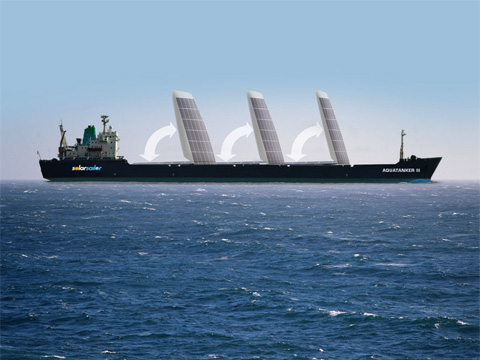 |
INVESTIGATION Does shipping have a green future? The aviation industry has its climate change plans, car manufacturers are working on 'eco' alternatives, and rail is considered top of the class, but what has the transport mode that delivers 90 per cent of goods to the UK done to improve upon its environmental credentials? |


